// capabilities
Everything a NETA shop runs on, in one place.
From the first nameplate to the sealed, customer-ready PDF - UltraDb covers the whole acceptance and maintenance testing workflow, field-first and offline-capable.
Work in English, Spanish, or Canadian French - forms, reports, and field help included.
// 01 - forms
Form authoring, free on every plan
Clone & customize
Fork any catalog form, edit fields, units, options, and tolerances, and publish in minutes - in the browser.
Spec-ordered layout
Sections follow the standard's sequence: identification, visual & mechanical inspection, then electrical tests in order.
Auto-graded at entry
Expected values and pass/fail limits show beside the reading - and oil results grade themselves against the right limit for the oil type and voltage class (ASTM D3487 / NETA MTS / IEEE C57.106 and C57.147, consolidating into IEEE C57.166), DGA included.
Versioned & audited
Every edit tracked to its author. Sealed results pin to the exact form version they were captured against.
107 forms, ready
A spec-authored library covering transformers, cables, breakers, switchgear, batteries, and the full ASTM D117 insulating-oil screen - the catalog default.
Portable
Clone and fork for a customer-specific variant. No proprietary sync lock-in.
Every form in the catalog traces back to a published test method. Browse the public reference to see the standard behind each one - what it is, why it matters, and how the result is judged.
Browse the reference →// 02 - field
Offline-first, signature to seal
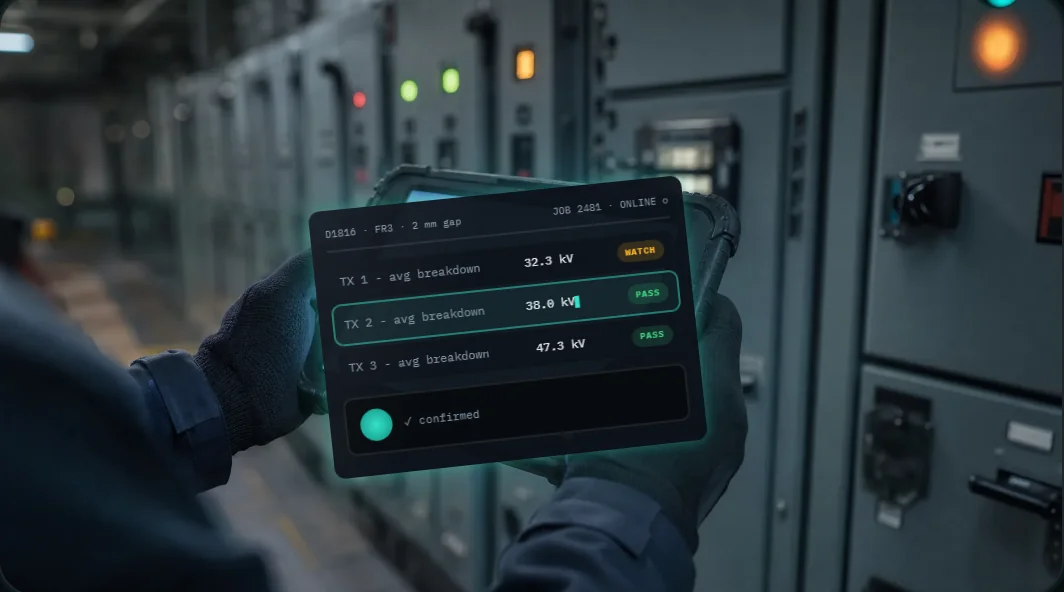
Capture offline
Pre-cache jobs before you drive out. Enter results, draw signatures, and complete tests with zero signal; sync on reconnect.
Pull-forward
Prior results surface beside the current test with deltas, so trending and repeat tests start from last time's data.
Same-day sealed PDF
A PE seals; the customer-ready report generates instantly with citations, calibration data, and deficiencies.
Photos & attachments
Attach nameplate photos and documents to assets and tests; images embed into the report appendix.
Install to home screen
A progressive web app - no app store, no install friction. Add to home screen and it behaves like a native app.
Import readings
Bring readings in from a test set's export file: map its columns or reading names to the form once, and the mapping is remembered per instrument model. Imported values grade exactly like typed ones, and each one keeps a note of the file it came from. Generic CSV today.
Voice mode
The app announces each field, you speak the reading, it reads the value back, and you confirm before anything is saved. The form's own acceptance rule gives the verdict, as it does for typed entry. Commands include confirm, redo, skip, back and repeat. English and Spanish first; French is in testing.
Checked on real devices
Every tablet, phone and laptop we list goes through the same recorded checks, from a whole test entered offline to gloves and sunlight. The device page shows where testing stands.
// 03 - shop operations
Assets, instruments, and the whole job
Asset health index
A rolled-up condition score per asset with insulating-fluid trending over time.
Calibration enforcement
Instrument calibration certificates tracked and printed on the report, with 12-month due warnings.
Instrument-form map
Recommend the right forms for the test set in hand, from a mapped instrument library.
Relay library
Hundreds of relay models with default settings to seed protection testing.
Team & roles
Invite members, assign roles, and review login activity from the account area.
Client portal
Each customer contact signs in with a link sent to their email and sees only their own sites, equipment, due dates, sealed reports and open items, under your logo and color. Read-only; revoke access from the customer page and see what was viewed.
Hand-off bundles
A ZIP per job or customer: the assets, one row per test with its verdict, every sealed PDF, a manifest with a checksum per file, and work-order and checklist sheets as flat sheets laid out for import into maintenance and commissioning platforms.
Report links
Share one sealed report through a secure link, with no account needed on the other end. Every access is logged.
Design partner program
Testing firms in the design partner program run UltraDb on live work before launch, on a multi-year license with no card on file, and help decide what ships next.
// 04 - standards
Built on the standards, and kept current
UltraDb Original forms
Where no published ANSI/NETA section covers the work, UltraDb authors an Original form on the standards that govern the equipment, with every line citing its source. In the catalog: 21. In review: 0. In development: 0. Every one is listed below.
A standards library behind the forms
More than 30 owned standards documents from NETA, ASTM, IEEE, NFPA and ANSI, each one digested or indexed so every form line traces to a clause. Owning the documents is how we check the forms; it is not an affiliation.
Every standards update, on one page
When a standard behind the forms is published, revised or withdrawn, it is listed on the standards updates page with the forms it affects, newest first. Signed-in users also get a notice bar.
Natural ester and silicone, graded as shipped
New natural ester fluid is graded as received against ASTM D6871-26, and new silicone liquid against ASTM D4652-20, property by property. The report says plainly what is not graded instead of borrowing a mineral-oil limit.
NFPA 70B-2026 intervals and condition
Maintenance due dates follow the NFPA 70B-2026 electrical testing intervals for each asset type, by condition 1 to 3. Each asset can be rated on physical condition, criticality and operating environment, with the overall condition set by the worst of the three. The mapping from our asset types to the standard's products is ours and is marked for engineer review before you rely on a due date.
A guided first run
A short tour of the top bar the first time you sign in, then tips that walk you through your first test, from the first customer to the shared report. Field capture works offline in English, Spanish or Canadian French, and results sync when the connection returns.
Verdict words that fit the form
A record form can name its outcome in its own words. The electrically safe work condition record reads Complete or Incomplete instead of Pass or Fail, on the screen, in the spoken readback, on the sealed PDF, in the client portal and in every export. Colors, filters and counts stay keyed to the same four outcomes, so a list of results still sorts the same way.
Limited-energy sources checked against the code tables
The cables, low-voltage, low-energy form grades a Class 2 or Class 3 power source against NEC Chapter 9 Table 11(A) and 11(B): marked volt-amperes and current, open-circuit voltage, and the measured current of an inherently limited source. Each inspection item names its clause in both the 2023 and the 2026 edition of the code.
A public reference under the help
Where a free United States government document, such as the Bureau of Reclamation's facilities instructions or the OSHA electrical regulation, describes the same practice as the standard a field cites, the field help carries a Reference line and the passage itself, word for word with its date. Twelve public documents and 1,517 reviewed passages today. The standard's citation stays on the limit, and nothing is graded differently.
// 05 - originals
Every UltraDb Original, and where it stands
This list comes straight from the form library: each Original, the standards it is built on, and whether it is in the catalog, in review or in development. Where a governing standard gives no acceptance value, the form records the reading against the manufacturer's data and does not invent one.
Arc Energy Reduction Systems
In the catalogStands beside ANSI/NETA ATS-2025 7.27, which the acceptance standard leaves reserved
Authored against- NFPA 70 (NEC)
- NFPA 70E-2027
- NFPA 70B-2026
- IEEE 1584-2018
Regulating Apparatus, Current
In the catalogStands beside ANSI/NETA ATS-2025 7.12.2, which the acceptance standard leaves reserved
Authored against- FAA AC 150/5345-10H
- IEEE C57.15-2017
Instrument Transformer, High-Accuracy
In the catalogStands beside ANSI/NETA ATS-2025 7.10.4, which the acceptance standard leaves reserved
Authored against- IEEE C57.13-2016
- IEEE C57.13.6-2005
- IEEE C57.13.1-2017
- ANSI C12.1-2026
Direct-Current Systems, Rectifiers
In the catalogStands beside ANSI/NETA ATS-2025 7.18.3, which the acceptance standard leaves reserved
Authored against- IEEE C57.18.10-2021
- IEEE 519-2022
- IEEE 946-2020
- NEMA PE 5-1997
- NEMA PE 7-2018
- IEEE C57.12.00-2021
- IEEE C57.12.01-2020
Wind Turbine Systems
In the catalogStands beside ANSI/NETA ATS-2025 7.30, which the acceptance standard leaves reserved
Authored against- IEEE 1547-2018
- IEEE 1547a-2020
- IEEE 1547.1-2020
- IEEE 2800-2022
- IEEE 2800.2-2026
- IEEE 81-2025
Cables, Low-Voltage, Low-Energy
In the catalogStands beside ANSI/NETA ATS-2025 7.3.1, which the acceptance standard leaves reserved
Authored against- NFPA 70 (NEC)
- ANSI/TIA 568.3-E
- ANSI/TIA 526-14-D
- ANSI/TIA 526-7-A
- ANSI/TIA 568.2-E
- ANSI/TIA 568.0-E
- ANSI/TIA 568.0-E-1
- ANSI/TIA 568.1-E
- ANSI/TIA 570-E
- ANSI/TIA 598-D
- ANSI/TIA 606-D
- ANSI/TIA 758-B
- ANSI/TIA 568.5
- ANSI/TIA 1152-A
Stationary Battery Capacity Test, Lead-Acid
In the catalogAuthored against- IEEE 450-2020
- IEEE P1188/D16
Soil Resistivity and Ground Electrode Resistance
In the catalogAuthored against- IEEE 81-2025
- ANSI/TIA 607-E
Harmonic Distortion Survey at the Point of Common Coupling
In the catalogAuthored against- IEEE 519-2022
Rotating Machinery Insulation Resistance and Polarization Index
In the catalogAuthored against- IEEE 43-2013
Revenue Meter Accuracy
In the catalogAuthored against- ANSI C12.1-2026
Inverter-Based Resource Interconnection
In the catalogAuthored against- IEEE 1547-2018
- IEEE 1547a-2020
- IEEE 1547.1-2020
- IEEE 1547.2-2023
- IEEE 1547.9-2022
- IEEE 2800-2022
- IEEE 2800.2-2026
Electrically Safe Work Condition
In the catalogAuthored against- NFPA 70E-2027
Telecommunications Bonding and Grounding
In the catalogAuthored against- ANSI/TIA 607-E
- ANSI/TIA 606-D
Coaxial Cabling (75 Ohm Broadband)
In the catalogAuthored against- ANSI/TIA 568.4-E
- ANSI/TIA 568.0-E
- ANSI/TIA 570-E
- ANSI/TIA 758-B
- ANSI/TIA 606-D
Telecommunications Labeling and Records
In the catalogAuthored against- ANSI/TIA 606-D
- ANSI/TIA 607-E
- ANSI/TIA 598-D
Telecommunications Pathway Installation
In the catalogAuthored against- ANSI/TIA 569-E
- ANSI/TIA 607-E
- NFPA 70
Telecommunications Space Environment
In the catalogAuthored against- ANSI/TIA 569-E
- ANSI/TIA 568.1-E
Telecommunications Rooms and Spaces
In the catalogAuthored against- ANSI/TIA 569-E
- ANSI/TIA 568.1-E
- ANSI/TIA 607-E
Outside Plant Pathway, Burial and Closure
In the catalogAuthored against- ANSI/TIA 758-B
- ANSI/TIA 607-E
Residential Telecommunications Infrastructure
In the catalogAuthored against- ANSI/TIA 570-E
- ANSI/TIA 607-E